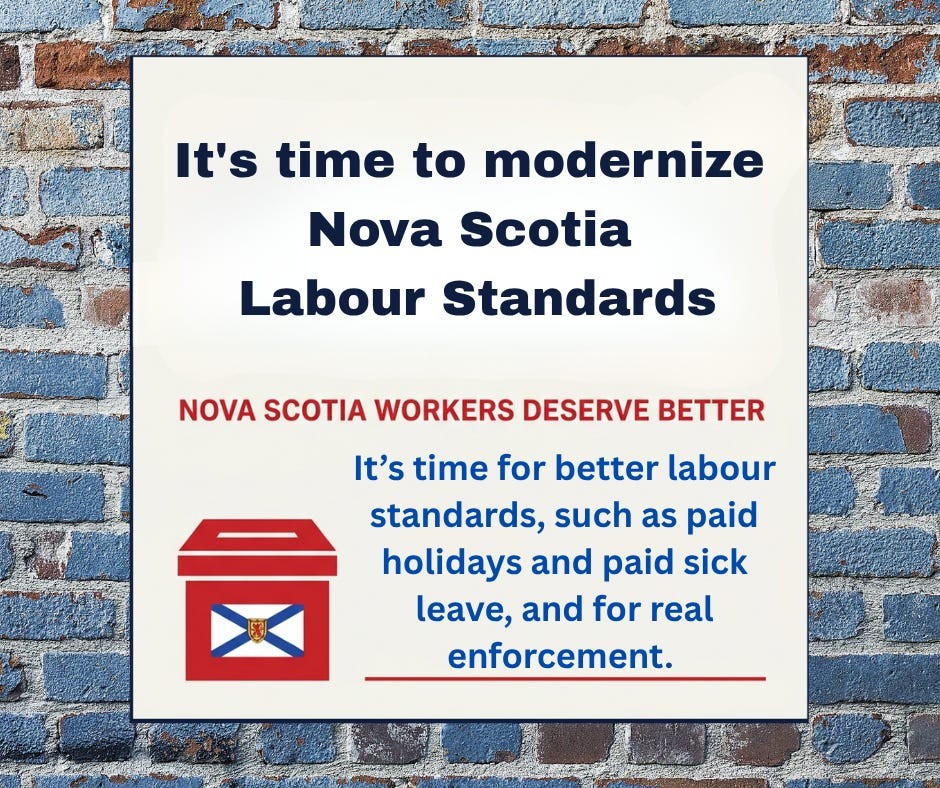
Is it really a long weekend for everyone? Nope. Nova Scotia politicians like to say our province is a good place to live and work; maybe that's true for them, but not everyone feels the same way. For far too many workers, the law tells a different story. The latest provincial estimate I found shows that about half the province's population of one million works in Nova Scotia, and tens of thousands are paid minimum wage or only slightly above it. Labour Standards have not been looked at in their entirety in more than fifty years. I think it's fair to say that, for us to attract more workers here, we need to rewrite our old and outdated Labour Standards to build fairness for workers so they stay and don't leave for greener pastures.
We all understand that Labour standards are supposed to be the floor. The basic rules that protect workers from unfair treatment and, sadly, that floor is far too low. The Canadian Centre for Policy Alternatives–Nova Scotia has found that our province lags behind other jurisdictions on basic protections for workers. policyalternatives
So there is a lot to be corrected, and far too much for this post, so we’ll cover a few. Let’s start with overtime. In Nova Scotia, most workers do not qualify for overtime until they have worked more than 48 hours in a week. In many other parts of Canada, overtime begins after 40 or 44 hours. But it gets worse. While the general rule is time-and-a-half of a worker’s regular wage, some workers are treated differently; for example, they are generally entitled only to time-and-a-half of the minimum wage after 48 hours, not time-and-a-half of what they actually earn. Think about that. Let’s say someone making $25 an hour could work long overtime hours and be paid based on the minimum wage instead of their regular pay. That is not fair. It is a loophole that rewards employers for demanding more hours from workers.
Paid holidays are another problem. Nova Scotia has only six statutory holidays, tied for the fewest in Canada. Workers must also meet strict eligibility rules to receive holiday pay. That can leave out, and it does, people in part-time, casual, gig and precarious jobs, most of the very workers who can least afford to lose income.
Then there are sick days. Nova Scotia has eight job-protected sick and family-responsibility days, but they are unpaid. For many low-wage workers, unpaid leave is not a real choice. A person may have to decide between going to work sick or missing rent, groceries, medication, or a power bill. No one should have to make that choice.
Nova Scotia also has no law stopping employers from taking tips meant for workers. Servers, bartenders, kitchen staff, delivery workers, and others depend on tips to make ends meet. Customers leave those tips for the people doing the work, not to add to an owner’s profits. Let’s face it: tips belong to the workers, full stop, and no employer should be able to make a cash grab from the workers they employ.
Wage theft is another major concern. A worker can file a complaint when an employer does not pay wages or overtime, but the process places too much burden on the worker. Even when workers receive an Order to Pay, there is no wage-protection fund to make sure they are paid if an employer refuses or cannot pay. It happened in a ruling from Nova Scotia’s Labour Standards Division when two workers were found to have an employer who owed them more than $10,000 and $6,000, respectively, in unpaid wages and other compensation. The division tried to collect from the company’s accounts but found no available funds, then closed both files as “uncollectible.” Their case shows the cruel gap in Nova Scotia’s system: workers can prove wage theft, win their case, and still receive nothing when an employer has no accessible assets.
Nova Scotia workers are not asking for special treatment. They are asking for basic fairness: to modernize labour standards to today’s standards, free of loopholes and equal to federal standards, to help level the playing field.
Take a minute and subscribe to my twice-weekly ramblings.
How about also sharing this and other posts?
These are my opinions written to get you thinking about what actually matters in this province. Fairness. Accountability. Who gets helped and who gets left out. Agree with me or don’t. But let’s have a respectful conversation.