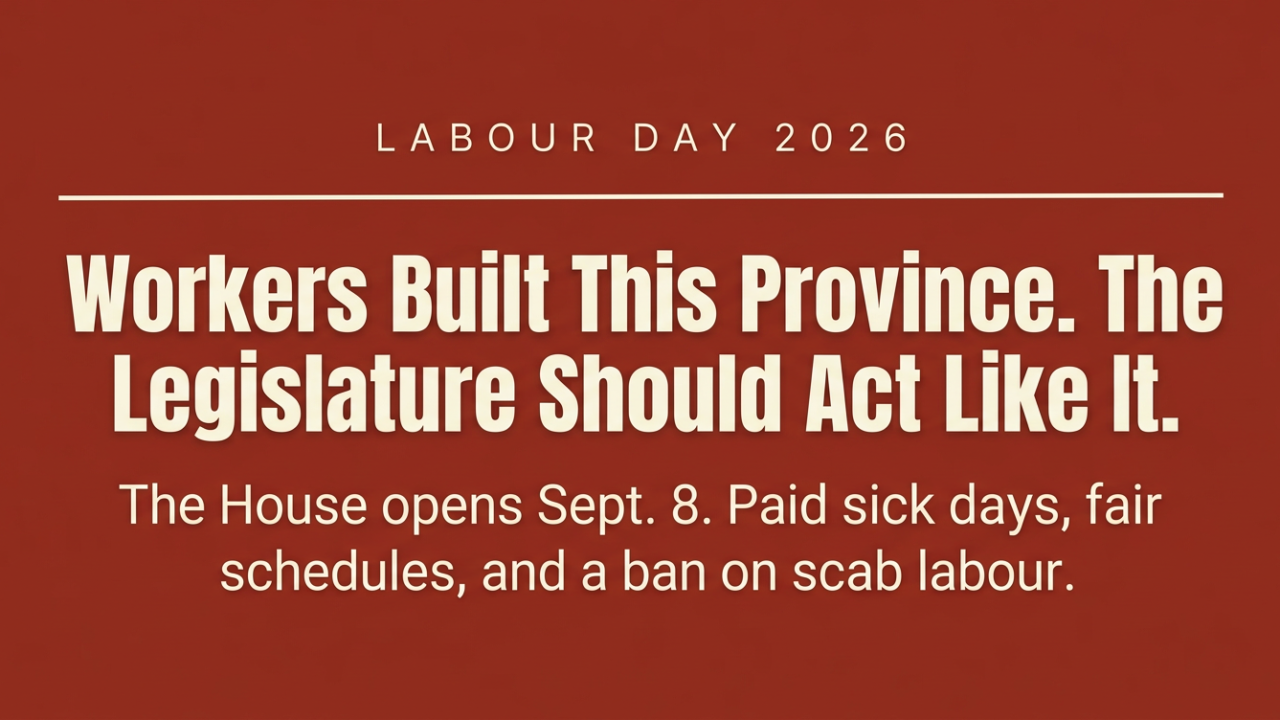
Labour Day is more than the last long weekend of summer. It was won by workers who marched, who struck, and sometimes went to jail for things we now take for granted. Things like the weekend, the eight-hour day, and the right to join a union. In 1872, Toronto printers walked out for a nine-hour day, and the parades that followed helped give us paid holidays and more.
Nothing for workers ever came without a fight. Nova Scotia law gives workers six paid statutory holidays a year. Six. That ties us with Newfoundland for the fewest in Canada. Prince Edward Island workers get eight. Ontario gets nine. British Columbia gets eleven. Even federally regulated workers in this province get ten. There is no good reason for us to be in last place. Ten paid statutory holidays, like the Federation of Labour is asking for, would not make Nova Scotia generous. It would make us average. Right now, we are dead last.
So on Tuesday, the Nova Scotia Legislature opens its fall sitting the day after Labour Day. It seems that the word out of Province House for the sitting will be affordability. There is no affordability fix that does not run straight through your paycheques or your working conditions, the workers who keep this province going.
On October 1, the minimum wage rises to $17 an hour. That is progress, and credit where it is due. But nobody raising a family in Truro, Sydney, or Halifax can call $17 a living wage, not with rents and grocery bills where they are.
Nova Scotia workers get five unpaid sick days. Unpaid. So the server with the flu and the home care worker with a bad back still face the same rotten choice: go in sick or lose a day’s pay. Let’s look at the government’s respect for bargaining rights. In March, the Nova Scotia Supreme Court ruled that Bill 148, the wage-freeze law the McNeil Liberals passed in 2015, was unconstitutional. The Tories, after them, promised to repeal that law and broke that promise. Bill 148 violated the rights of 75,000 public sector workers. For eleven years, those workers waited. That is what happens when governments treat bargaining as an inconvenience.
Then there is the issue of work scheduling. Ask anyone in retail or food service what their week looks like. The schedule goes up Sunday for a Monday start. Shifts appear and vanish by text the night before. You cannot line up childcare, book a medical appointment, or keep a second job when your hours are a guessing game. And here is the part that should embarrass us. Since 2019, Canadian federal law has given federally employed workers the right to see their schedule in writing four days ahead, plus the right to say no to a last-minute shift. If that is good enough for a bank clerk in Halifax, it is good enough for a waitress in New Glasgow. Two weeks’ notice of schedules is not a big ask. It is the difference between having a job and having a life.
Nova Scotia’s Labour Standards Code does not count tips as pay, so an employer can legally pocket a server’s tips. Quebec law says tips belong to the worker. Ontario banned tip theft back in 2016. Here, bills to fix it were introduced in 2018 and 2023, but neither went anywhere. When you leave a ten on the table, you mean it for the waitress, not the owner. A tip theft law doesn’t have to be complicated, but our Nova Scotia government just hasn’t bothered. Clearly, the fight for workers in Nova Scotia is not over.
So I don’t expect much out of this session of the legislature, but if there is a hint of good news for workers in our province, it is that a workers’ agenda exists. The Nova Scotia Federation of Labour delivered one to the government on August 31, ahead of this sitting. It’s not radical; it’s about fighting to change workplace laws that affect all workers. Ten paid sick days. Ten paid statutory holidays. Three weeks’ vacation after a year on the job. Two weeks’ notice of work schedules. A ban on tip theft. Real enforcement of labour standards, so the rules on paper are the rules at work.
These measures would put money in people’s pockets, improve working conditions, and increase job security for ordinary people. So this Labour Day, enjoy the picnic and the parade. But when the House opens on September 8, remember what the day is for.
Nothing on this list will happen because politicians woke up feeling generous. Change will happen the way it always has: with workers standing up, getting organized, and making it happen. The long weekend in September was not a gift, nor were the eight-hour day, the minimum wage, the right to bargain, and many other things we have today, even as weak as they might be.
Affordability starts with decent work, and decent work starts with you. Workers built this province, and workers must set its agenda. Nobody is coming to do it for us. It is us helping us, the way it has always been.