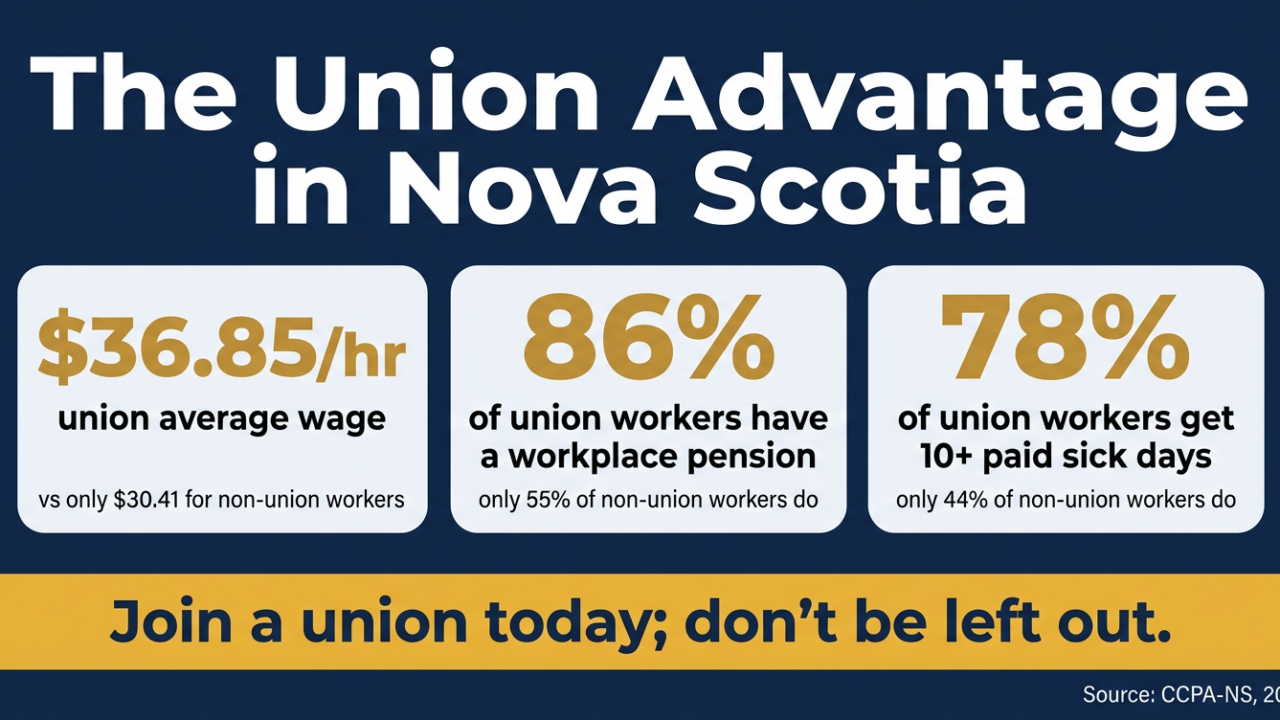
This information comes from the Canadian Centre for Policy Alternatives’ recent September 2026 report, which you can find here. The report highlights the Union Advantage in the province, and this page shares that information because a union job can mean better pay, more paid sick days and a pension. The report from the Canadian Centre for Policy Alternatives Nova Scotia (CCPA-NS) compares unionized and non-unionized jobs in our province. It also explains why forming a union here can be so difficult.
Information on how to join a union is below; check it out because a union job can mean better pay, more paid sick days and a pension.
Better pay
In 2025, unionized workers in Nova Scotia earned an average of $36.85 an hour, compared with $30.41 for non-unionized workers. That is a difference of $6.44 an hour. Their average weekly earnings were $1,377 and $1,119, respectively.
The report puts Nova Scotia’s average living wage at $27.60 an hour. The average union wage was $9.25 above that mark. The average non-union wage was $2.81 above it.
Low wages were less common in unionized jobs. Seven per cent of unionized workers earned less than $20 an hour, compared with 30 percent of non-unionized workers. Among part-time workers, average weekly earnings were $596 in unionized jobs and $365 in non-unionized jobs.
These are averages, not a promise of what any one worker would earn by joining a union. The report says its Nova Scotia wage figures show a difference between the two groups; they do not, by themselves, prove that union membership caused the whole gap.
More paid sick days
Being able to stay home when you are sick matters. In the report’s survey, 92 percent of unionized workers had at least one paid sick day, compared with 79 percent of non-unionized workers.
The gap was wider for workers with 10 or more paid sick days a year: 78 percent of unionized workers had them, compared with 44 percent of non-unionized workers. That does not mean the other 56 percent of non-unionized workers had no paid sick days. Some had fewer than 10.
Better health benefits
Unionized workers in the survey were more likely to have these benefits from their employer:
| Employer benefit | Unionized | Non-unionized |
|---|---|---|
| Prescription coverage | 90% | 73% |
| Vision care | 90% | 70% |
| Dental care | 88% | 73% |
| Extended health benefits | 89% | 69% |
Better access to a pension
A workplace pension can make retirement more secure. In the survey, 86 percent of unionized workers had a workplace pension plan, compared with 55 percent of non-unionized workers.
Non-unionized workers were more likely to have an employer-contributed RRSP, at 47 percent, compared with 30 percent among unionized workers. The report says workplace pensions tend to benefit workers, though the value of any plan depends on its terms.
Raises and family supports
Unionized workers were also more likely to report regular pay increases and a top-up to parental leave pay:
| Employer benefit | Unionized | Non-unionized |
|---|---|---|
| Regular pay increases | 83% | 66% |
| Parental leave top-up | 50% | 28% |
| Paid training or tuition rebates | 53% | 45% |
What union members say
The report asked people in unionized jobs what benefits they saw from union membership. Their most common answers were better pay (73 percent), better job security (71 percent), better health and safety protections (64 percent), and better access to breaks (49 percent).
Younger unionized workers also pointed to hours and scheduling. Among those aged 18 to 34, 54 percent reported improved hours and 50 percent reported improved scheduling.
The report found a smaller pay gap between women and men in unionized jobs: 11 percent, compared with 21 percent in non-unionized jobs. It cautions that differences between public- and private-sector work help explain some of that gap.
Why more workers need access
In 2025, only 31 percent of Nova Scotia employees were unionized or covered by a collective agreement. Union coverage was high in public administration (76 percent), education (70 percent), and health care and social assistance (62 percent). It was much lower in retail (5 percent) and accommodation and food services (4 percent).
The report says Nova Scotia’s rules make it hard to form a union, especially for workers on different shifts or at different locations. Workers must first gather signed union cards from at least 40 percent of the proposed group. They then face a separate vote. Delays can leave a union drive in limbo.
CCPA-NS recommends making it easier to certify a union when 50 percent plus one of workers sign cards. It also calls for stronger protections when service contracts change hands, better access to help in securing a first contract, and the repeal of the Michelin Amendment, which imposes additional organizing limits on some manufacturing workers.
How to join a union in Canada
Every worker in Canada has the legal right to join a union, regardless of province or whether the workplace falls under provincial or federal labour law. The Canadian Labour Congress outlines the basic steps to getting into a union: How it works.
- Contact a union organizer. The CLC will introduce you to an experienced organizer in your area. Your first conversations are confidential.
Where to get help in Nova Scotia
Canadian Labour Congress, Atlantic Regional Office (Halifax)
- Website: canadianlabour.ca/contact
- Address: 1718 Argyle Street, Suite 420, Halifax, NS B3J 3N6
- Office hours: Monday to Friday, 9:00 a.m. to 4:00 p.m.
- Phone: 902-455-2965
- Email: atlantic@clcctc.ca
Nova Scotia Federation of Labour (Halifax)
- Website: nslabour.ca/contact-us
- Address: 3700 Kempt Road, Suite 225, Halifax, NS B3K 4X8
- Phone: 902-454-6735
- Office hours: Monday to Friday, 8:00 a.m. to 4:00 p.m.
About the report
This article draws on “One of the hardest places to organize in the country”: Understanding and overcoming barriers to unionization in Nova Scotia, by Rachel K. Brickner, Rebecca Casey, Ruby Harrington and Daniel Cerdas Sandí, published by CCPA-NS in September 2026. It is part of the Advancing Decent Work series.
The wage figures come from the report’s analysis of Statistics Canada data. The sick-day, pension and other benefit figures come from its 2025 Nova Scotia Precarity Survey of 552 employed adults aged 18 to 65. The report says those survey percentages describe the people surveyed and should not be treated as estimates for every worker in Nova Scotia.